Why does your QA team need a professional Test Management System?
Ben from Company X has always assumed he can manage QA without a Test Management System (TMS). He believed in his team’s ability to handle everything manually, relying on spreadsheets, emails, and sticky notes to keep track of tests, bugs, and team progress. In fact, Ben's team was even able to allocate the budget for a simple bug-tracking tool this year. So they should be fine now, right? Wrong. Although Ben is a good and hard-working guy, in this article, we explore why you should not be like Ben and invest in a professional TMS before it's too late.
A TMS for QA is not a nice-to-have for growing teams. It is the difference between a QA process that scales and one that quietly breaks under the weight of spreadsheets, duplicated test cases, and missed defects.
Teams without a TMS spend an estimated 30 to 40 per cent of their testing time on non-testing work: finding the right test case, checking which version was last run, chasing defect status across email threads.
The three sections of every QA process a TMS transforms are test case management, defect tracking, and reporting. Manual tools handle none of these well at scale.
Choosing the right TMS for QA means matching the tool to three things: team size, integration requirements, and whether AI-assisted test generation is a priority.
Implementation does not need to take months. Most teams reach operational readiness within two to four weeks with the right migration support and onboarding structure.
A TMS beats spreadsheets on every dimension that matters at scale: version control, traceability, real-time reporting, and the ability to run automation results alongside manual test cases in one view.
The Role of a TMS in QA
A TMS for QA is the central hub that connects every part of your testing process: test case creation, execution, defect tracking, reporting, and integration with your development pipeline. Without it, those parts exist in separate places and someone on your team spends their day manually connecting them.
Imagine your QA process as a complex puzzle, with each piece representing a crucial aspect of ensuring product quality and reliability. Now, imagine trying to solve that puzzle without a guiding framework or structure. That’s where TMS steps in – it provides the essential framework that holds your QA process together, enabling you to navigate the intricacies of software testing with efficiency and precision.
At its core, a Test Management System is the central hub for all your QA activities. It provides a unified platform where you can create, organise, execute, and track test cases, ensuring comprehensive test coverage and meticulous documentation of results. Think of it as your QA command centre, empowering you to orchestrate your testing efforts easily. Now, let’s return to Ben’s story, in which he has never used a TMS.
Challenges of the QA process without a TMS
A TMS for QA is the central hub that connects every part of your testing process: test case creation, execution, defect tracking, reporting, and integration with your development pipeline. Without it, those parts exist in separate places and someone on your team spends their day manually connecting them.
See if some of these challenges look familiar to you:
Absence of AI Capabilities: Life without AI in 2024? Hard to imagine. Without AI capabilities, you will lose your opportunity to accelerate testing and eliminate routine. Manual testing processes consume excessive time and are prone to errors. Tasks such as test case prioritisation and defect prediction are labour-intensive. So, Ben’s QA team lacks the speed and precision necessary to meet modern industry demands. If you don’t use a TMS, so is yours.
Lack of Reporting and Dashboards: In today’s data-driven world, lacking reporting and dashboards is like navigating in the dark. Without these tools, you’re left guessing your project’s progress and overall quality. Ben’s team struggles to track test coverage, monitor progress, and identify bottlenecks effectively. They cannot make informed decisions or allocate resources optimally without real-time insights. So, if you don’t want to let your team stumble in the dark, you must embrace a TMS for transparency and visibility, just like Ben should.
Inadequate Test Case Management: In the age of digital transformation, relying on scattered documents for test case management is like using a map without coordinates. Due to inadequate management practices, Ben’s team struggles with version control issues, duplication, and inconsistency in their test cases. This wastes time and increases the risk of overlooking critical test scenarios. By implementing a TMS, you centralise your test case management, ensuring easy access, version control, and consistency across your QA process. Not using an effective TMS lets your test cases get lost in the shuffle.
Poor Defect Tracking and Management: Every defect left untracked potentially threatens your product’s quality and reputation. Ben’s team faces difficulty tracking and managing defects effectively without a robust system. Defects reported through emails or spreadsheets often lead to delays in resolution and communication gaps. This compromises product quality and erodes customer trust. With a TMS, you gain a centralised defect tracking and management platform, enabling timely resolution and communication and ultimately ensuring a superior product experience for your customers. Don’t let defects slip through the cracks.
How do you face all these challenges altogether? There is a solution that will cover all these needs: aqua cloud. Using aqua cloud, you unlock a world of benefits that revolutionise your QA processes. Experience accelerated AI-powered testing, ensuring faster delivery times and improved product quality. Gain unmatched transparency and visibility with intuitive reporting and dashboards, empowering informed decision-making and resource allocation. Seamlessly synchronise your data processes with smooth integrations, enhancing team collaboration and efficiency. Centralise your test case management for streamlined workflows and improved consistency. With aqua cloud, you can effortlessly track and manage defects, ensuring a superior product experience for your customers.
Automate 200% of your QA where automated testing can’t
Test Management System vs Spreadsheets and Bug Trackers
Most teams that resist adopting a TMS for QA are not using nothing. They are using a combination of Excel or Google Sheets for test cases, Jira or a similar bug tracker for defects, and email or Slack for status updates. This feels manageable until it stops being manageable, usually around the point where the team grows past five testers or the product grows past a certain number of modules.
Here is what each comparison actually looks like at scale.
Test case management
Spreadsheets store test cases as rows. They have no version control, no execution history, and no link between a test case and the requirement it covers. When a requirement changes, finding every affected test case is manual work. In a TMS, test cases are versioned, linked to requirements, and searchable by module, priority, or coverage status. A single filter shows you exactly which tests need review after a requirements change.
Defect tracking
A bug tracker like Jira was built to track development issues, not to connect defects back to specific test cases and the requirements they trace to. In a TMS, a defect is automatically linked to the test case that found it, the requirement it relates to, and the test run it appeared in. That chain gives you root cause analysis in seconds rather than hours of cross-referencing.
Reporting
In spreadsheets, someone has to build every report manually, pull data from multiple sources, and update it for every status meeting. A TMS for QA generates real-time dashboards showing pass/fail rates, defect density by module, test coverage by requirement, and release readiness at a glance. No manual compilation, no data that is already outdated by the time it is shared.
Automation integration
Spreadsheets cannot receive automation results. A bug tracker can log a failure ticket but cannot show you the automated test run that produced it alongside the manual tests from the same cycle. A TMS integrates with Selenium, Appium, Jenkins, Azure DevOps, and REST API so automated and manual results live in one place and report together.
The honest summary: spreadsheets and bug trackers are fine for very small teams working on very simple products. The moment either of those conditions changes, a TMS for QA pays for itself in the time it saves.
Benefits of using a TMS to unlock your potential
A professional TMS for QA delivers measurable improvements across every stage of the testing lifecycle: faster test cycles, better defect visibility, AI-assisted coverage, and the kind of audit-ready traceability that manual approaches cannot produce.
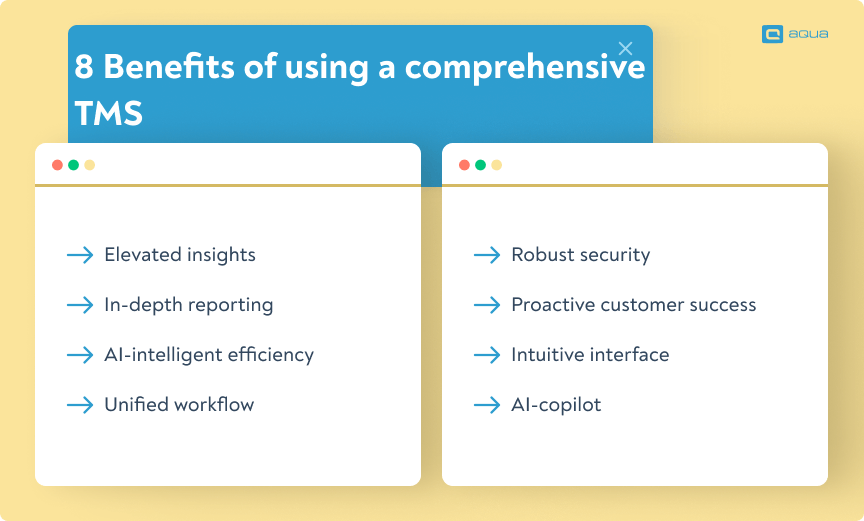
1. Elevated insights
Imagine having everything related to your testing in one convenient place, all working together seamlessly. That’s what a TMS offers. With a TMS like aqua cloud, Ben can manage his testing process effortlessly, unlike his previous manual methods. While Ben struggles with scattered documents and using different tools for tasks, companies utilising TMS enjoy a cohesive and well-organized testing environment. From creating tests to tracking results, a unified test system ensures thorough testing coverage and meticulous record-keeping. Companies leveraging TMS benefit from streamlined workflows, improved collaboration, and enhanced productivity, surpassing those like Ben who rely solely on manual approaches.
2. In-depth reporting and smart dashboards
Having a comprehensive view of your testing process at your fingertips, ready whenever needed, is one of the most crucial Test Management System benefits. Unlike Ben’s manual methods, which leave him struggling to keep track of everything with basic reports and no real-time updates, companies using TMS benefit from in-depth reporting and smart dashboards. These tools provide valuable insights into their testing, helping them understand trends, make informed decisions, and drive improvements. With a TMS, like those used by these companies, you can elevate his understanding of your testing process and make better decisions, just like Ben should.
3. AI-Intelligent efficiency
Consider how much easier it would be if your testing process could handle some of the work for you. Yes, we are talking about AI-enhanced automation. But not every TMS in the market offers this. You should choosethe best test management solutions, like aqua cloud, that give you the power of AI. Instead of relying solely on human effort, companies using TMS like aqua cloud benefit from AI-enhanced automation. This means repetitive tasks can be automated, and intelligent algorithms can optimise test execution. With AI-enhanced automation, testing cycles will be accelerated, allowing Ben and his team time to focus on more strategic activities. By embracing AI-driven efficiency, you can achieve more in less time, surpassing the limitations of manual approaches.
4. Unified workflow
Seamlessly connecting all your tools and processes can make your work much smoother. That’s the advantage a TMS like aqua cloud brings. Unlike Ben’s fragmented approach, where different tools and systems are used for different tasks, companies using TMS benefit from a unified workflow. Everything from requirement management to defect tracking to test environment management is connected and synchronised within a single platform. With a unified workflow, you can collaborate more efficiently, information flows seamlessly between different stages of the software development lifecycle (SDLC), and there’s no need to waste time switching between multiple tools. By embracing a TMS, you achieve cohesion and efficiency that surpasses the disjointed processes of manual approaches.
Choosing a TMS depends how many manual test cases you have and how much documentation of test cases you need for regulatory compliance.
Ensuring the security and integrity of your testing environment is crucial for safeguarding sensitive data and maintaining compliance with industry regulations. A modern Test Operations Management System should offer robust security compliance measures to address these concerns. Unlike Ben’s manual methods, which may leave data vulnerable to breaches or non-compliance issues, companies using secure TMS benefit from built-in security features and stringent compliance protocols. This ensures that your testing data remains protected and confidential, reducing the risk of data breaches or regulatory penalties. With tools like aqua cloud, you can trust that your testing environment meets the highest security standards, providing peace of mind and confidence in your QA process.
6. Proactive customer success
One of the biggest headaches Ben has is that he is alone all the time. As a QA manager, he handles everything by himself, affecting his mental health and motivation. But if he switched to a TMS with great customer success, he would never feel alone again in his job. He would always contact the customer support team with any concerns he had. This ensures that any challenges or questions are addressed promptly, allowing teams to stay focused and productive. With TMS, companies can achieve greater success in their testing endeavours, thanks to the ongoing support and assistance provided. But again, not every TMS. You should choose your AI test management tool wisely.
7. Intuitive and customisable interface
Navigating and interacting with your testing platform should be effortless and tailored to your team’s preferences. A TMS like aqua cloud offers an intuitive and customisable interface. Unlike Ben’s struggle with outdated interfaces and limited customisation options, you can enjoy a user-friendly experience that can be personalised to suit your workflows. This intuitive interface enhances user satisfaction and productivity, allowing you to focus on their testing tasks without unnecessary hurdles. It also comes in handy when onboarding new team members. With TMS, companies can effortlessly adapt their testing environment to meet their evolving needs and preferences.
8. AI as your guardian angel
Imagine having a friend alongside you who is ready to help you in all steps of your QA process. A robust TMS will give you exactly that – a QA equivalent of ChatGPT. Having an AI-Copilot can revolutionise your testing process by augmenting human intelligence with machine-driven insights and capabilities. Unlike Ben’s reliance solely on human effort and intuition, you can use AI-driven insights and suggestions to enhance your testing strategies. This creative intelligence lets you explore innovative approaches, identify hidden patterns, and drive product quality and performance breakthroughs. With AI as a co-pilot, companies can unlock new levels of efficiency, innovation, and success in their testing endeavours.
Is there a solution that provides all these benefits? It may sound too good to be true, but with aqua cloud, it’s a reality. aqua cloud offers a comprehensive solution that addresses every aspect of your testing process. aqua cloud has everything from unified test ecosystems to in-depth reporting, AI-enhanced automation and robust security compliance. By embracing aqua cloud, you can save your test management and strategy from the pitfalls of manual approaches and unlock the full potential of your testing efforts. Say hello to a future of streamlined, efficient testing with aqua cloud.
Achieve 100% painless and transparent test management with aqua
Choosing a TMS for QA is not a feature checklist exercise. Most tools on the market have broadly similar feature sets. The differences that matter show up in how well the tool fits your team’s specific context.
Start with team size and structure
A five-person QA team working in a single Agile squad needs something different from a 50-person QA function spread across multiple product lines. Smaller teams benefit from tools that are fast to set up and easy to maintain without a dedicated admin. Larger teams need role-based access control, cross-project reporting, and the ability to standardise processes across teams without losing flexibility at the squad level.
Check integration depth, not just integration presence
Most TMS tools list Jira, Azure DevOps, and Jenkins in their integrations page. What matters is how deep those integrations go. A surface-level Jira integration creates a ticket when a test fails. A deep integration provides bidirectional sync: requirements from Jira flow into the TMS, test results flow back, and defects created in the TMS appear as linked Jira issues with full context. Ask for a demo of the specific integration your team depends on before committing.
Evaluate AI capabilities honestly
AI test generation is becoming standard. The quality difference between tools is significant. Generic AI that generates test cases from a description is useful but limited. A domain-trained AI that understands your project’s own requirements, documentation, and existing test library generates coverage that is specific and directly usable rather than generic and in need of heavy editing. aqua cloud’s aqua Intelligence is trained on your project data, not on general QA patterns, which means the test cases it generates reflect how your application actually works.
Consider migration effort
If your team has years of test cases, execution history, and defect data in another tool, the migration cost is real. Look for TMS providers that offer migration support, data mapping assistance, and a clear timeline. aqua cloud’s one-click migration from TestRail and other tools takes on average one day while preserving full revision history.
Think about compliance requirements
If your industry requires audit trails, traceability matrices, or documented evidence of test execution for regulatory purposes (FDA, ISO, SOX, GDPR), your TMS needs to produce that documentation automatically rather than requiring you to assemble it manually before every audit.
Test Management System Implementation Best Practices
The most common reason TMS implementations fail is not the tool. It is the approach: trying to migrate everything at once, skipping the onboarding structure, and expecting the team to adopt new workflows without a transition plan.
These practices keep implementation on track.
Start with one project, not all of them
Pick a single active project and implement the TMS there first. This gives the team a real-world environment to learn the tool, surface configuration questions, and identify workflow adjustments before rolling out to the entire organisation. A pilot project also produces a concrete before-and-after story that builds internal support for the broader rollout.
Define your test case taxonomy before importing
The biggest migration mistake is importing existing test cases into a new TMS without first deciding how they will be organised. Define your folder structure, naming conventions, priority levels, and requirement linking approach before any data moves. Changing these after import is significantly harder than getting them right at the start.
Map every integration before go-live
List every tool your TMS needs to connect with: Jira, CI/CD pipelines, automation frameworks, reporting tools. Test each integration in a staging environment before go-live. Integration failures discovered after go-live interrupt testing cycles and create urgency that leads to workarounds that become permanent.
Set up traceability from day one
Requirements to test cases to defects is the traceability chain that justifies using a TMS for QA over a spreadsheet. If you implement the TMS without setting up traceability links from the start, you will lose the most significant benefit of the tool. Make requirement linking a required field in your test case creation workflow so it cannot be skipped.
Run a parallel period of two to four weeks
Keep the old system running alongside the new TMS for a short parallel period. This reduces the risk of losing data or process continuity during the transition and gives the team confidence that the new tool is working correctly before the old one is retired.
Train to workflow, not to features
Most TMS onboarding focuses on features: here is how to create a test case, here is how to run a test execution. More effective onboarding focuses on workflows: here is how to set up a sprint testing cycle, here is how to generate a release readiness report, here is how to trace a defect back to its source requirement. Workflow training produces adoption. Feature training produces a team that knows the buttons but does not change how they work.
Final words: fast forward to Ben’s fate
After contacting us and implementing aqua cloud, Ben’s testing process underwent a remarkable transformation. Gone are the days of scattered documents, manual inefficiencies, and fragmented workflows. With aqua cloud, Ben is free from the headaches of managing his testing process manually. No longer does he struggle to keep track of test cases or juggle multiple tools for different tasks. Instead, he enjoys the seamless management and unified workflow aqua cloud provides. The reporting and dashboards provide valuable insights, enabling him to make data-driven decisions and drive continuous improvement. AI-enhanced automation accelerates testing cycles, allowing Ben and his team to focus on strategic activities. Ben is happy, so are we. We talk to tens of businesses where people like Ben experience the same daily challenges. And we transform their whole testing process to a new level. Are you ready to join them? Contact us, and let us handle all your headaches for you.
Your test management efforts involve critical elements for better software quality and efficiency:
Test Planning – Defines objectives, scope, strategies, resources, and timelines.
Test Design – Converts requirements into test cases. It ensures a comprehensive coverage of functionalities.
Test Execution – Runs test cases, logs results, and identifies defects for resolution.
Defect Management – Tracks, prioritises, and resolves bugs to maintain software quality.
Test Automation – Enhances efficiency by automating repetitive tasks related to testing. It reduces manual effort.
Traceability & Reporting – Links requirements to test cases and provides actionable insights.
Collaboration & Integration – Guarantees smooth coordination between teams and easy tool integrations.
For effective test management, you should go for a TMS like aqua cloud that delivers you all with 100% efficiency. With aqua, you save 42% of your time in test planning and design stages, manage your defects, use automation integrations, achieve 100% traceability, and improve communication with all stakeholders.
What is the golden rule of QA?
“Test early, test often.”
Bugs cost less to fix when caught early. Waiting until the last minute turns a small issue into a major headache.
In QA, you don’t just find defects—you need to prevent them. The sooner you test, the smoother your release.
What is the biggest challenge in QA?
Keeping up with change.
With new features, tight deadlines, and shifting requirements, QA has to adapt fast without letting quality slip. Automating tests helps, but flaky tests and maintenance slow things down.
The real challenge is balancing speed and reliability while making sure nothing critical breaks.
That’s where you need a reliable TMS that will deliver all – speed, automation integrations, AI-powered features, security and centralised platform to manage all your tests in one place. And that is aqua cloud.
How do you know when your team needs a Test Management System?
The clearest signals that a TMS for QA is overdue are operational rather than theoretical.
Test cases exist in multiple files with no single source of truth, and nobody is confident which version is current.
Defects are being discovered in production that testers could have caught, but did not, because coverage was undocumented.
Release readiness reports take one or more days to compile manually and are outdated by the time they are presented.
New testers take more than a week to understand where things are and how the process works.
Regulatory audits or compliance reviews require scrambling to assemble documentation that should already exist.
If two or more of these are true, the team is already absorbing the cost of not having a TMS. The question is not whether to implement one but how quickly.
What features should every modern Test Management System include?
A modern TMS for QA should cover these capabilities as standard, not as add-ons.
Test case management with version control and full execution history.
Requirements traceability that links test cases to requirements and defects to test cases, creating an end-to-end evidence chain.
Real-time dashboards showing test coverage, pass/fail rates, and defect density without manual report compilation.
Native integration with Jira, Azure DevOps, and CI/CD pipelines like Jenkins and GitHub Actions.
Automation result management so automated and manual test results report together in one view.
AI-assisted test generation that reduces the time from requirement to executable test case.
Role-based access control for teams where different stakeholders need different levels of visibility.
Audit trail and compliance documentation for regulated industries.
Bug tracking or seamless defect integration so defects found during testing stay linked to their source test case.
What features should every modern Test Management System include? aqua cloud covers all of the above, with the addition of Capture for one-click bug reporting with automatic video, console logs, and environment data attached.
How long does it take to implement a Test Management System?
For most teams, a TMS for QA reaches operational readiness in two to four weeks. The timeline breaks down like this.
Week 1: Configuration and migration. Set up the project structure, user roles, and integrations. Migrate existing test cases from spreadsheets or the previous TMS. aqua cloud’s migration from TestRail takes on average one day with full revision history preserved.
Week 2: Integration testing and workflow definition. Test all integrations with Jira, CI/CD, and automation frameworks in a staging environment. Define the standard workflows for test execution, defect creation, and reporting.
Weeks 3 and 4: Parallel running and training. Run the new TMS alongside the existing system for two weeks. Conduct workflow-focused training with the team. Retire the old system once the team is confident.
Larger organisations with multiple teams and complex compliance requirements typically take six to twelve weeks for a full enterprise rollout. The pilot project approach reduces this risk by proving the implementation in a single team before expanding.
Stefan is an entrepreneur who deeply believes in technology. With his company, andagon Group, he’s been empowering businesses around the world to build better software through their quality assurance services and products since 2001. Stefan has cultivated a knack for tailoring aqua to seamlessly integrate…
Nurlan, a QA Coordinator & Quality Standards Officer, takes pride in orchestrating seamless QA operations. His expertise in coordinating QA-focused projects and integrating QA solutions has consistently yielded top-tier client satisfaction. Aside from a full-time QA coordinator, Nurlan's role involves creating compelling content that educates…
Home » Best practices » Why does your QA team need a professional Test Management System?
Do you love testing as we do?
Join our community of enthusiastic experts! Get new posts from the aqua blog directly in your inbox. QA trends, community discussion overviews, insightful tips — you’ll love it!
We're committed to your privacy. Aqua uses the information you provide to us to contact you about our relevant content, products, and services. You may unsubscribe from these communications at any time. For more information, check out our Privacy policy.
X
🤖 Exciting new updates to aqua Intelligence are now available! 🎉