Test Prioritisation Strategies for Continuous Deployment Scenarios
In continuous deployment scenarios (CDs), you automate almost every step of the process, including testing. But that does not mean you can approach every step of the testing process the same. In a moment of urgency, how do you decide which tests to prioritise so you don’t slow down the process? This guide will show you why test prioritisation is so crucial for CDs.
Test prioritisation is determining the order in which tests should be executed based on their importance, risk, and impact on the software under test. In the context of CD, test prioritisation becomes especially crucial.
In continuous deployment, code changes are rapidly deployed to production, that’s why the time available for testing is often limited. Test prioritisation ensures that critical tests, which cover essential functionality and high-risk areas of the application, are executed first. By focusing on these priority tests, you can quickly identify and address critical issues that could impact the software’s stability or usability.
In fact, one study shows that organisations that have adopted CI/CD practices, which include rigorous test prioritisation, experience significant benefits: they have 25% faster lead times and 50% fewer failures compared to those that don’t. This demonstrates the value of effective test management in maintaining the pace and quality of continuous software delivery.
Additionally, test prioritisation helps optimise testing efforts by ensuring that valuable resources, such as time and manpower, are allocated effectively. By prioritising tests based on their significance and potential impact on the CD pipeline, teams can streamline the testing process and accelerate the delivery of reliable software updates to end users.
So what did we learn? In a nutshell, test prioritisation for CDS is crucial because:
It helps identify high-risk areas
It allows to optimise resource allocation
Eventually, it leads to faster and more reliable updates
But as you can predict, the process is not always smooth and you’ll encounter different challenges on the way. Which ones, we discuss next.
Challenges in test prioritisation for continuous deployment
As you wish to maintain the delicate balance between speed and quality, you should consider the following challenges:
Limited Timeframes: With rapid code deployments in CD, there’s often limited time available for testing. Prioritising tests becomes critical to ensure you conduct essential checks within tight timelines.
Dynamic Codebase: CD involves frequent code changes, leading to a dynamic and evolving codebase. Keeping test priorities aligned with these changes will be challenging, as new features or modifications shift over time.
Resource Constraints: Limited resources, such as testing environments and manpower, can significantly challenge your test prioritisation. Optimising the use of available resources while ensuring comprehensive test coverage requires careful planning and strategy.
Risk Management: Identifying and prioritising high-risk areas of the application is essential in continuous deployment. Here is the challenge: accurately assessing and managing risks across a rapidly changing codebase is complex, and requires you to deeply understand the system’s architecture and dependencies.
Maintaining Test Suites: As test suites grow in size and complexity, maintaining them becomes increasingly challenging. Test prioritisation involves regularly reviewing and updating test suites to ensure they remain relevant and effective in identifying potential issues.
Integration Testing: Coordinating integration tests across multiple components and services can be challenging in continuous testing and deployment environments. Prioritising integration tests based on their impact on critical workflows and system functionality is essential to maintaining overall system integrity.
Balancing Speed and Quality: Perhaps the most significant challenge in test prioritisation for continuous deployment is striking the right balance between speed and quality. While the goal is to deliver updates quickly, you can not compromise the thoroughness and effectiveness of testing.
The major caveat I would throw in regarding the priority of testing is also identifying what things would be fixed if they were identified as broken. I've worked with several projects where they wanted to "automate everything" but would not prioritise fixing the things that were found by automated tests, and some defects, they stated that they wouldn't fix them at all.
Enough of the challenges, right? Where are the solutions? Before we move on to the strategic solutions, it’s time to bring up an all-in-one solution that will revolutionise how you conduct test prioritisation.
Ready to optimise your test prioritisation for continuous deployment? aqua testing tool is an AI-powered Test Management System (TMS) that seamlessly integrates with tools like Azure DevOps, giving you a comprehensive view of all your tests—manual and automated. aqua streamlines not only your CI/CD pipeline but your entire testing effort, enhancing efficiency and effectiveness. With advanced test case and requirements management, along with integrated bug-reporting tools like Capture, aqua ensures smooth and thorough testing processes. Elevate your continuous deployment strategy and overall testing efficiency with aqua.
Automate 200% of your testing efforts with an AI-powered TMS
Now that we know the challenges associated with test prioritisation in continuous deployment scenarios, let’s explore the strategies to effectively address these issues and ensure smooth and reliable software releases. Here are some proven strategies for effective test prioritisation:
Risk-Based Testing: Focus on identifying and prioritising tests for the most critical and high-risk areas of your application. By concentrating on components that have the highest impact on functionality and user experience, you can mitigate potential issues early in the deployment process. There are various formal methodologies and frameworks to approach this, such as ISO 9126 for software quality, Hazard Analysis, and Failure Mode and Effect Analysis (FMEA). However, many teams still prefer more simplified and informal methods to achieve similar outcomes.
Historical Data Analysis: Use historical test data and defect reports to identify patterns and prioritise tests that have previously uncovered significant issues. This helps in focusing efforts on areas that are prone to bugs and require more rigorous testing.
Test Coverage Analysis: To ensure that your prioritisation strategy covers all essential features and functionalities of the application, start by defining key areas that need thorough testing. Use code coverage tools to analyse which parts of the codebase are being exercised by your tests. Identify untested or under-tested areas and create or enhance tests to improve overall coverage. Regularly review and update your test coverage metrics to ensure comprehensive testing as the application evolves.
Automated Regression Testing: Implementing automated regression tests involves several steps. First, identify the core functionalities of your application that must remain stable. Use testing frameworks like Selenium, JUnit, or TestNG to develop automated test scripts that cover these functionalities. Integrate these tests into your CI/CD pipeline using tools like Jenkins or GitLab CI. This setup allows you to run regression tests automatically with each new code commit, ensuring that changes do not introduce new bugs. Prioritise maintaining and updating these tests to adapt to new features and changes in the application.
Frequent Smoke Testing: Conduct smoke tests frequently to ensure that the most basic and critical functionalities of the application are working correctly. To do this, start by defining the critical functionalities of your application that need to be checked regularly. Develop a suite of smoke tests that cover these functionalities, using tools like TestCafe or Cypress for web applications. Integrate these smoke tests into your CI/CD pipeline to run them automatically with every build or at scheduled intervals. This approach will help you detect fundamental issues earlier. Then, you monitor the results of these tests continuously and adjust the test suite as necessary to cover any newly identified critical functionalities.
Customer-Focused Testing: Prioritise tests based on customer usage patterns and feedback. By focusing on features and areas most used by customers, you can ensure a better user experience and higher customer satisfaction.
Adaptive Approach: Be flexible and adapt your test prioritisation strategy based on the context and evolving requirements of the project. Regularly review and adjust priorities to align with the current development and business goals.
If you implement these strategies, you will comfortably enhance your test prioritisation efforts, ensuring that critical tests are executed first and your CD pipeline remains efficient and robust.
Risk-based testing sounds straightforward in theory: prioritize high-impact, high-probability scenarios. But in practice, accurately assessing risk is a skill that takes years to develop. Think you can spot which deployment scenarios pose real threats versus false alarms? Test your risk calibration against real-world outcomes in this interactive assessment.
🎯 Interactive Risk Calibrator Game
▼
Test your risk assessment skills! You'll see 9 real-world software scenarios that teams faced during deployment decisions.
Your mission: Click on a matrix cell (e.g., "High Impact, Low Probability"), then click on a scenario card to place it in that cell.
You have 90 seconds to place all 9 scenarios. Work quickly but thoughtfully—just like in real deployment decisions!
After completion, you'll see the actual outcomes and get a personalized risk calibration profile.
Time Remaining
90
Scenarios Placed
0/9
IMPACT
PROBABILITY
High
Medium
Low
Low
Medium
High
📦 Click a cell, then click a scenario to place it
How do you implement test prioritisation in CD effectively?
Implementing test prioritisation in CD environments requires a systematic approach. You need to ensure that critical tests are executed efficiently and effectively. Here are key steps to help you implement test prioritisation successfully:
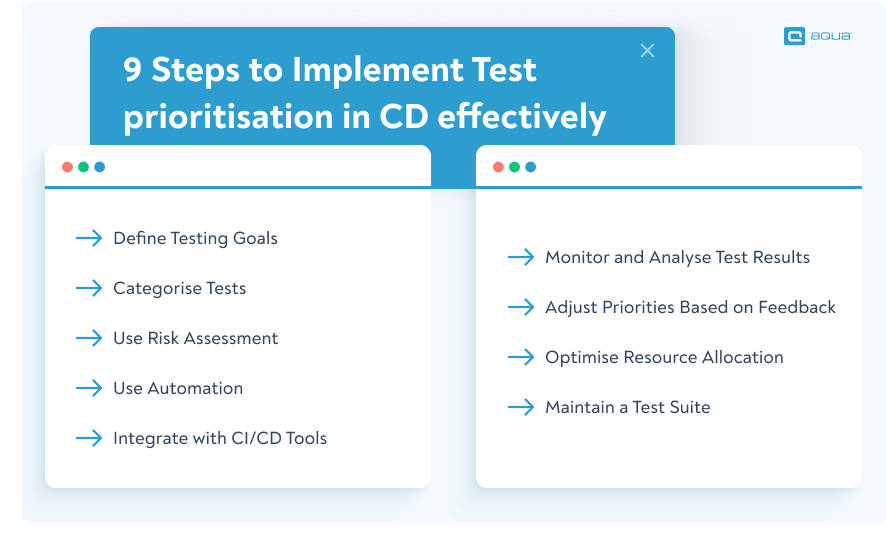
Define Testing Goals: Clearly outline your testing objectives and priorities. Determine which areas of your application are most critical and align your testing efforts to focus on these high-impact areas.
Categorise Tests: Organise your tests into categories based on their importance, such as critical, major, and minor. This helps in systematically prioritizing which tests to run first based on their significance to the overall application.
Use Risk Assessment: Conduct a risk assessment to identify the most vulnerable areas of your application. Prioritise tests that cover these high-risk areas to prevent critical issues from reaching production.
Use Automation: Implement automated testing for repetitive and high-priority tests. Automation helps in executing these tests quickly and consistently, ensuring that essential functionalities are validated with every deployment.
Integrate with CI/CD Tools: Connect your test management system with CI/CD tools like Jenkins, Azure DevOps, or GitLab. This integration allows for automatic triggering and prioritisation of tests as part of the continuous deployment pipeline.
Monitor and Analyse Test Results: Continuously monitor test results and analyse patterns to identify recurring issues. Prioritise tests that frequently uncover defects, ensuring these areas receive adequate attention.
Adjust Priorities Based on Feedback: Regularly review and adjust your test priorities based on feedback from development teams, test results, and production incidents. This adaptive approach helps you stay aligned with the evolving needs of the project.
Optimise Resource Allocation: Efficiently allocate resources, such as testing environments and manpower, based on test priorities. Ensure that high-priority tests have the necessary resources to be executed without delays.
Maintain a Test Suite: Regularly update and maintain your test suite to ensure it remains relevant and effective. Retire obsolete tests and add new tests for recently developed features to keep your test suite comprehensive and up-to-date.
These steps complement a complete approach to effectively implementing test prioritisation in your CD pipeline, ensuring that critical tests are executed promptly and your software releases are reliable and robust.
The future of test prioritisation in continuous deployment
So, what does the future hold for test prioritisation in continuous deployment? How will test prioritisation be carried out in the future? And how will AI affect it? Here are some key trends and advancements we can expect:
Increased AI Integration: AI and machine learning will play a more prominent role in test prioritisation. AI can analyse vast amounts of data to predict which tests are most likely to fail and prioritise them accordingly, increasing efficiency and reducing the risk of defects reaching production.
Predictive Analytics: Leveraging predictive analytics, future test management systems will forecast potential problem areas based on historical data and trends. This will enable teams to proactively focus their testing efforts where they are most needed, improving overall test effectiveness.
Enhanced Automation: Automation will become even more integral, with more sophisticated automated testing frameworks capable of adapting to code changes in real-time. This will streamline test prioritisation, allowing for continuous and seamless testing throughout the deployment cycle.
Deeper Integration with DevOps Practices: Test prioritisation will become more deeply integrated with DevOps workflows. Continuous feedback loops and real-time analytics will ensure that test priorities are constantly aligned with development and operational needs, fostering a more collaborative and efficient environment.
Real-time Risk Assessment: Advances in risk assessment tools will enable real-time evaluation of code changes, identifying and prioritising tests based on immediate risk factors. This will help in dynamically adjusting testing priorities to reflect the current state of the codebase.
Scalable Testing Solutions: As applications grow in complexity, scalable testing solutions will become essential. Cloud-based testing environments and distributed testing frameworks will allow for scalable and flexible test prioritisation, accommodating the needs of large, complex projects.
Shift-Left Testing: The shift-left approach will gain more traction, with testing activities moving earlier into the development cycle. Early prioritisation of tests will help identify and resolve issues sooner, reducing the cost and impact of defects.
Enhanced Collaboration Tools: Future test management systems will offer better collaboration tools, enabling seamless communication between developers, testers, and operations teams. This will ensure that test prioritisation decisions are well-informed and aligned with the broader goals of the project.
By embracing these trends and advancements, teams can look forward to a more efficient, effective, and responsive approach to test prioritisation in continuous deployment, ultimately leading to higher-quality software and more reliable releases.
To stay ahead of these trends, consider using aqua, an AI-powered TMS that seamlessly integrates with your CI/CD pipeline and excels in test planning capabilities. aqua stands out by incorporating AI to generate requirements, test cases, and even test data in seconds. This boosts your testing efficiency, eliminating much of the manual and routine work, and allowing you to focus on more strategic topics such as risk assessment and monitoring. Experience the future of test management today with aqua and elevate your continuous deployment strategy. Try aqua now and see the difference it can make for your team.
Automate 100% of Your Test Prioritisation and Management
In this guide, you learned about the challenges of test prioritisation in CD and explored effective strategies to overcome them. We covered the importance of risk-based testing, leveraging historical data, and integrating with CI/CD tools to streamline your testing efforts. Equipped with these solutions and relying on powerful tools like aqua, you can enhance your test prioritisation, ensuring efficient and reliable software releases. The question is: are you ready to implement these strategies and take your continuous deployment process to the next level?
Test prioritisation is about deciding which tests to run first based on risk, impact, and resources. The goal is to focus on the critical areas more likely to fail or affect users.
High-Risk Areas – Test parts with the highest risk of failure or impact on the system.
New Code – Prioritize testing new features or changes.
Regression – Run tests that cover core functionality that’s most likely to break.
It’s about not wasting resources by testing everything if it’s not likely to break. You need to focus on what matters most.
What is CD in testing?
CD stands for Continuous Delivery (or Continuous Deployment) in testing. It means automatically testing and deploying code changes to production in small, frequent updates.
In testing, CD ensures that every change is automatically tested for quality before being deployed. The goal is to make it faster to catch bugs and release stable features. As a result, you need to reduce manual effort and risk, while ensuring that the application is always ready for release.
How to give priority in testing?
To prioritise testing, focus on these key areas:
Risk-Based – Test the most critical features that affect users or business processes.
Change-Based – Prioritize tests on recently changed or newly added features.
Frequency – Focus on areas that are tested the most and are prone to issues.
User Impact – Test features that directly impact the user experience or revenue-generating parts of the app.
Always aim to test what’s most likely to fail and what matters the most to the business.
Robert has several years of experience in process optimisation and test management. He is an expert in defining and implementing workflows by adapting aqua to the clients’ processes.
Nurlan, a QA Coordinator & Quality Standards Officer, takes pride in orchestrating seamless QA operations. His expertise in coordinating QA-focused projects and integrating QA solutions has consistently yielded top-tier client satisfaction. Aside from a full-time QA coordinator, Nurlan's role involves creating compelling content that educates…
Home » Best practices » Test Prioritisation Strategies for Continuous Deployment Scenarios
Do you love testing as we do?
Join our community of enthusiastic experts! Get new posts from the aqua blog directly in your inbox. QA trends, community discussion overviews, insightful tips — you’ll love it!
We're committed to your privacy. Aqua uses the information you provide to us to contact you about our relevant content, products, and services. You may unsubscribe from these communications at any time. For more information, check out our Privacy policy.
X
🤖 Exciting new updates to aqua Intelligence are now available! 🎉